

4.00pm – Sunday 1 November ‘Church Done Differently’ Light Party

 The Vine and the Vine-Grower
I was pondering a new hobby – owning a vineyard! Sell some wine, drink some stock, make some money! However, it’s not that simple.
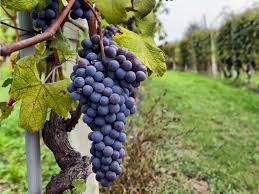
Grapevines take great care and time. It takes three years to produce fruit, even six with some. Vines should be pruned and trained to grow along a trellis or wires.
Vines grow best in the dirt that other plants dislike; rocky hillsides with low yielding soils. It takes many vines to make one good bottle of wine. It’s expensive to start a vineyard and takes many years before the owner sees a return on their investment. Suddenly, it’s not so attractive!
Is it unusual then, that something so difficult would be the example Jesus used when talking about the relationship between God and His people?
Not really, because these are the perfect type of fields to demonstrate God’s relationship with His kingdom.
Think about it:
We’re difficult to tend. We’re like that low yielding soil, full of rocks and like a steep hillside .We take careful pruning and time before we produce good fruit. We’re costly.
Despite this God, the faithful vineyard owner, cares for us lovingly and with patience. He works the soil and prunes us, the branches intertwined with the vine itself that is Jesus, perfectly to produce fruit for the kingdom.
Revd. Neil Redeyoff,
Rector of The Parish of Holy Trinity and St Oswald’s, Finningley, with St Saviour’s, Auckley

My dear friends in Christ,
I suppose you will by now have heard, or seen reports of, the statement made by the Prime Minister tonight. I am sure it has come as a great shock even to those who have suspected that this step was bound to be taken eventually.
May I urge you please to comply fully with these severe restrictions and not to look for ways around them. Further advice will follow, probably tomorrow, about eg. emergency baptisms and numbers who might attend funerals.
But for now the message is clear:
Please stay at home; Please close your church buildings and keep them closed.
There are to be no more baptisms or weddings for the time being.
Please pray for the mercy and deliverance of God.
Please care for the vulnerable and be gentle with yourself.
Please do what you can, even from home, even while you are separated from family, friends and neighbours, to seek the perfect love which casts out fear, and to invest in relationship and community.
And now may the peace of God, which passes all understanding, keep your hearts and minds in the knowledge and love of God and of his Son, Jesus Christ our Lord. And the blessing of God Almighty, the Father, the Son and the Holy Spirit, be among you and remain with you always. Amen.
+ Pete
The Rt Revd Dr Pete Wilcox
Bishop of Sheffield
Dear Friends
‘Do not be afraid, little flock, for it is your Father’s good pleasure to give you the kingdom’.
Luke 12.32
This is a time of considerable anxiety in the Diocese, as we feel our way into an uncertain future. I want you to know that I am not immune from that anxiety – but that I am drawing comfort from these words of Jesus, spoken to his disciples as they too felt their way into an uncertain future. Of course, the kingdom of which Jesus was speaking is not the same as the institution of the Church of England and offers no guarantee as to the future shape of the Church of England. But I find these words an encouragement nevertheless and I hope you might too. I take heart from the summons not to be afraid, from the reminder that we are the Lord’s own ‘little flock’ and from the
knowledge that the Father’s good pleasure is assured.
In that spirit, I am writing to bring you all up to date with developments in the Diocese with regard to the future deployment of stipendiary clergy posts. I intend to write an Ad Clerum on this subject once a month for the next six months, in the first week of each month, as one reliable channel of communication — even if sometimes there will be little to report.
In December I forwarded a briefing document I had prepared for Bishop’s Council and Diocesan Synod. This letter is an attempt to summarise developments since that paper was circulated.
However, I want to begin by setting our challenges in context. It is important for everyone to understand that the challenges we are addressing are a) not new ones to Sheffield and b) not local to Sheffield.
The challenges are not new to Sheffield. Over Christmas and the New Year, as some of you know, I was reading a document published in November 1998, called ‘The Diocesan Strategy, 1999-2004: A Consultative Document’. It states, baldly, that ‘We do not in fact believe that our current patterns of church life and ministry are sustainable as they stand in an area such as ours’. It goes on to explain that ‘the parish system now faces urgent pressures deriving mainly from the problem of insufficient resources especially to pay clergy stipends. It is a known fact that the numbers of clergy are being reduced in this diocese. We shall be required to lose 5 posts per year over a period of 5 years (ie 25 in total)’. It concludes ‘We cannot expect the remaining clergy to absorb the additional workload’. It is my own view that this is in fact exactly what has happened in this Diocese over the past 20 years since the publication of that report — and that our structures are now at breaking point as a result. Many of you were part of this journey even then, and you know better than I do that there is at least a 20 year history to the challenges we are now having to address.
But in the last 15 months, since I laid out the issue in my Presidential Address to Synod in November 2018, it has become clear that the challenges are not local to Sheffield either. If you have access to the internet, you might like to look at the ‘People and Places’ programme in the Diocese of Birmingham; or at the consultation paper now published on the website of the Diocese of Manchester. The national church is so acutely aware that the challenges we are facing are general to the northern, urban, post-industrial, post Victorian dioceses that the Church Commissioners announced to General Synod in July a new £45m Diocesan Sustainability Fund, to enable Dioceses like ours to re-structure to achieve full genuine sustainability, in the present triennium (2020-2022).
It was suggested to our senior staff team this week that the Diocese of Sheffield finds itself in the prow of the good ship Church of England. To change the image, we will be among the Dioceses pioneering a path which others will then follow.
In that context, where have we got to? What have been the chief developments since I circulated that briefing paper last autumn and what will happen next?
1. Towards the end of last year, after an extensive consultation in which many of you engaged, the senior staff team agreed a model which assumes (and secures) a total of 77 stipendiary ‘oversight minister’ posts in the Diocese to 2025, and draft proposals for the way we expect to allocate these stipendiary posts in each pair of twinned deaneries (Snaith and Hatfield with Adwick le Street; Wath with Tankersley; Doncaster with West Doncaster; Rotherham with Laughton; Attercliffe with Ecclesall; Ecclesfield with Hallam). The question is simply how we can deploy reduced resources more fruitfully for the sake of the Gospel and of God’s coming kingdom, seeking to follow Jesus in the power of the Spirit to the glory of the Father.
2. In January, a series of meetings were held between Area Deans and Lay Chairs from each pair of ‘twinned Deaneries’ and members of the Parish Support Team, with maps, to look at how these indicative allocations of stipendiary posts might be deployed on the ground. I am told that these meetings were consistently constructive and encouraging. I am grateful to those involved for the spirit in which they have engaged with this process and embraced the journey ahead.
3. There now follows a two month period (ie February and March), in which we are asking Area Deans and Deanery Lay Chairs to facilitate local consultation in each pair of deaneries, sharing these provisional plans and draft maps with the respective Deanery Mission & Pastoral Committees, Chapters, Deanery Synods and PCCs, to gather responses to both the proposed ‘mission areas’ and the proposed deployment of stipendiary oversight ministers.
4. As most of you will be aware, we are expecting that, locally, congregations are led more and more by volunteer lay leaders (called focal ministers). We are aware of the concern many have voiced, that in many situations these focal ministers may prove hard to find: it is a concern we share — though we are much encouraged by the first pilot projects we have been trialing.
5. The draft maps and indicative deployments have been carefully considered by PST, Archdeacons, Area Deans and Lay Chairs, but they are by no means cast in stone at this point. The consultation is genuinely open to alternative suggestions about how we could respond more fruitfully to local missional opportunities with the resources we have available. However, the ‘ceiling’ of 77 posts will only rise as and when additional funding for stipends is secure.
6. By the end of March, we have asked Area Deans and Lay Chairs to negotiate with their respective Archdeacons to take into account possible amendments raised during this consultation period. Then in April and May, the senior staff will then finalise these plans, with a view to taking them to the Diocesan Mission and Pastoral Committee in May.
7. However, as I have been at pains to emphasise repeatedly, there is no ‘guillotine’ date at which we will suddenly transition to a new model. We are on a journey. It is as a matter of fact a journey which has been underway for about 30 years, since the late 1980s, when there were 164 stipendiary incumbents in this Diocese.
8. At the time of writing, there are still 91.5 DBF-funded stipendiary incumbents in our Diocese. There is no date at which this number will be suddenly reduced to 77. For the rest of 2020 and into 2021 and beyond, we will continue to inch our way to the indicative model agreed next May, although along an unwavering direction of travel: ‘to grow a sustainable network of Christ-like, lively and diverse Christian communities in every place which are effective in making disciples and in seeking to transform our society and God’s world’.
9. My senior staff colleagues and I want to recognise how stressful and difficult this process is proving — for lay people and clergy alike: for church wardens (especially in the increased numbers of parishes in vacancy); for licensed and authorised lay leaders; for self-supporting clergy; for curates; for interim ministers; for stipendiary incumbents. We are seeking to do everything we can to minimise uncertainty, by communicating clearly, consistently and frequently.
10. We will make mistakes, I’m afraid, and we will try your patience. But we ask for your forbearance: no Diocese has completed this transition before, so there is no precedent for us to follow. That fact also accounts for the extent to which you will understandably feel goal posts are moving and deadlines slipping. They are, though we are working hard to minimise these too.
11. In particular, my senior staff colleagues and I want to recognise that it is bound to seem (in the short term) to lay people and clergy alike that you are being asked to produce more with less: like the Israelite slaves in bondage to Pharaoh, asked to keep up the brick quota only now without straw (Exodus 5). This is detrimental, not least, to the wellbeing of all concerned.
12. We know this and we are working hard to address it. In particular, we are determined that those who take up posts as stipendiary Oversight Ministers will find them designed to be ‘do-able’ in a healthy number of working hours per week: duties and expectations will be defined and agreed by PCCs, clergy and the senior staff so that we do not repeat the mistake of the past decades by simply spreading the residual number of stipendiary incumbents more thinly.
13. The goal is not oppression but liberation — this is the point of our strategy: renewed, released, rejuvenated! Our aim is to mobilise the whole people of God for the whole mission of God. The primary measure of this will be our ‘Lights for Christ’ initiative: we are seeking to enable all the baptised to enter into the full dignity of their baptismal vocation to shine as lights for Christ in the world, by the power of the Spirit, to the glory of God the Father.
14. We are working closely with colleagues from the national church to ensure that a bid to the Diocesan Sustainability Fund will provide some additional resources to enable this ‘release’: providing buildings and operations support at parish level for example. We are currently exploring with the Church Commissioners a proposal to submit a phase 1 bid quite soon, with a fully fledged phase 2 towards the end of this year. This would make us the first beneficiaries of the new fund — although it is important to note that this is new territory for the Church Commissioners too and the process is therefore uncertain!
15. Meanwhile, I am heartened to have completed a round of appointments to the vacant posts on my senior staff team. Following the exciting appointment of Canon Sophie Jelley, announced in December, we have now been successful in making equally encouraging appointments to the posts of Archdeacon of Doncaster and Diocesan Secretary (CEO of the DBF). Announcements about those
appointments will follow in the coming days. Meanwhile, you are all invited to the consecration of Canon Sophie at York Minster on the Feast of the Annunciation (Wednesday 25 March) at 11am and to her installation in Sheffield Cathedral on Saturday 28th March at 2pm.
16. Finally, thank you to all of you who are praying each day the Diocesan Vision Prayer. The Lord will hear us and bless us.
Living God, Jesus calls his followers to seek first your kingdom.
Renew us, as we make your love known.
Release us, to share freely together in mission; and Rejuvenate us, to be fruitful in your service.
Give us courage, wisdom and compassion
that strengthened with the grace of the Holy Spirit
we may, as the Diocese of Sheffield, both flourish and grow through Christ our Lord.
Nothing in this Ad Clerum is confidential, though obviously much of it is sensitive: do please therefore feel free to share any or all of it with your PCC0(s), or with your congregation(s) more widely.
I am grateful for the assurance many of you have given me of your prayers during this period of challenge and change. I am seeking to serve you in the Spirit of Jesus, to the best of my ability, and I know my senior colleagues would say the same.
With every blessing in Christ
Dr Pete Wilcox
Bishop of Sheffield
Thy Kingdom Come is a global prayer movement that invites Christians around the world to pray for more people to come to know Jesus. What started in 2016 as an invitation from the Archbishops of Canterbury and York to the Church of England has grown into an international and ecumenical call to prayer.
Join Bishop Pete and Christians from round the diocese for a lively service of prayer and praise at Sheffield Cathedral.
Guest preacher: Revd Canon Kate Wharton, Assistant National Leader New Wine.
This is also a diocesan event for our growing 2025 prayer community.
During the 11 days of Thy Kingdom Come (30th May – 9th June), it is hoped that everyone who takes part will
For more information click on the link below
“Imagining the Good News: Inhabiting and commending the beauty of the Christian Faith through storytelling and poetry.”
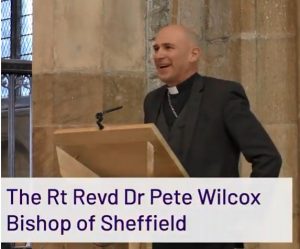
The Bishop of Sheffield’s Annual Lecture 2019
It is now three months since I addressed the last Diocesan Synod. In my presidential address on 24 November 2018, I spoke about the four-headed beast threatening our diocese, something that I think we are all familiar with now. Just in case you need a reminder, the four-headed beast is:
Attendance trends: numbers are still falling, or at best are barely holding their own
Significant financial challenges across most parishes and for the Diocesan Board of Finance: budgets are in deficit
In many places church structures (buildings, rules and compliance regulations) are not what we would choose
The demographics of our congregations are imbalanced and we depend too heavily on our older members
My address in November focussed on B for budgets. With the Diocesan budget for 2019 needing approval, this head was snarling most ferociously. You can watch my full presidential address online at https://www.youtube.com/watch?v=n2fqLAki-n0.
A Task and Finish group commissioned by the Bishop’s Council has been meeting on average every two weeks since October 2018. It has been wrestling with the fact that, while at the end of 2018 we had 103 stipendiary incumbents in the Diocese of Sheffield, in fact (were it not for the sale of three properties), we could afford only 90 this year. But what is especially challenging for the Bishop’s Council is the knowledge that we cannot be certain of our capacity to maintain income levels. For this reason, the Task and Finish group is working on a plan for the deployment of our stipendiary clergy which assumes only 75 stipendiary incumbents and a drop from 12 to 6 deaneries. I am personally visiting every deanery in the first 6 months of this year, with other members of the senior staff team, to explain this situation and to invite comments and questions. I have so far been to Adwick le Street, Ecclesfield and Rotherham, with visits to Wath, Tankersley, and Snaith & Hatfield scheduled before Easter.
The group also commissioned a review of Church House, to ensure that, in light of the new strategy, our central function is well-placed to deliver. This review is now complete and its findings will be incorporated into the proposals now under consideration. From this point, the anticipated timeline is as follows:
By March 2019, the task and finish group will present a mature model for the deployment of fewer clergy (likely 75) to the Bishop’s Council (12th) and Diocesan Synod (23rd).
Assuming no substantial amendments are demanded from Council and Synod, we hope this model can then be circulated between Easter and June for consultation with PCCs, with a request for responses by July 5th, to inform Diocesan Synod on
July 13th
This proposal will then be worked up into an implementation plan, to be published in the autumn, for implementation to begin in 2020 — I hope the new plan will be adopted by Diocesan Synod in November this year.
Whatever the final form of the agreed proposal, the transition from where we are to where we want to be will not take place overnight. There will be no sudden drop in the number of stipendiary clergy. In fact, we will have to inch our way towards a new model. Progress will be slower than we would like and will be more expensive too, because of the nature of the common tenure and freehold protection which stipendiary clergy enjoy. This is probably a good thing, in God’s providence: it will prevent us from rushing into anything. We will continue to offer updates on this through a number of outlets as the weeks progress.
Meanwhile, let me reaffirm my sense of God’s providence here: although it is true that we are having to respond to financial pressures, the real impetus is, I am convinced, coming from the Holy Spirit. We are being called by God to be renewed in our
dependence on his grace and power, to be released as the baptised people of God into the whole mission of God, and to be rejuvenated so that we can serve every local community across the Diocese more vigorously and effectively. We are being called to a renewal of our dedication to the Lord Jesus and to one another in his service, and to recover the sense of mission which is at the heart of God’s Church. Those of us who have been called to ordained ministries are being thrown back upon the One who has called us. At our ordination as Deacons and / or Priests we were reminded:
The Church is the Body of Christ, the people of God and the dwelling-place of the Holy Spirit. In baptism the whole Church is summoned to witness to God’s love and to work for the coming of his kingdom. To serve this royal priesthood, God has given a variety of ministries. Deacons are ordained so that the people of God may be better equipped to make Christ known. Priests… share with the Bishop in the oversight of the Church, delighting in its beauty and rejoicing in its well-being… With the Bishop and their fellow presbyters, they are to sustain the community of the faithful by the ministry of word and sacrament, that we all may grow into the fullness of Christ and be a living sacrifice acceptable to God.
I am confident that, in God’s grace, this process will enable all of us, lay and ordained, to fulfil our callings more fully, so that the Church of God in the Diocese of Sheffield can fulfil its vocation more fully too.
+ Pete
Posted by Bishop Pete on 26th February 2019
© 2026 St Mary's Church Tickhill. Website Design and Build by Hildred Design